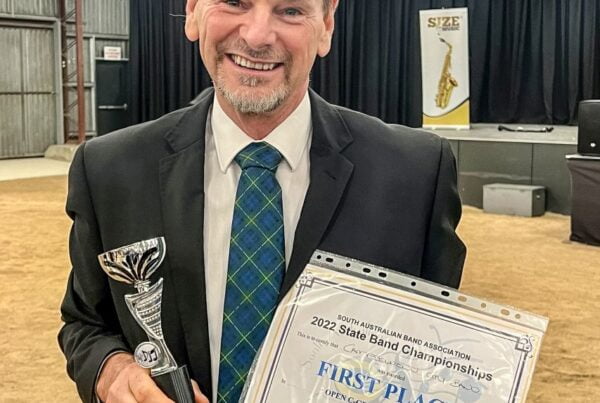
In the late 19th century the predominantly farming communities in the Eastern suburbs of Adelaide had many small groups of men who came together to play brass band music for their own enjoyment and for that of their communities. Magill Silver Band, Athelstone Brass, Eastern Suburban Boy’s Band, and Eastern Star were just some of the small bands in local communities. Some eventually amalgamated and the Murray Park Band, pictured around 1915, became the basis for the Campbelltown Brass Band. Note the “ring-in” in the back row with different uniform and a clarinet! It was in 1919 that the Campbelltown Brass Band was officially formed by Mr Arthur Hazelwood. It consisted of young learners and market gardeners, all male of course. This undated photo must be prior to 1930 when uniforms were first provided. The annotation on the back of this photo of Mr Jack Homeward indicates he was Musical Director from around 1920 to 1933. Did Arthur Hazelwood not continue for long or is the information, only recently recalled, not correct? Jack is shown in the uniform of the Campbelltown Silver Band so the photo is likely to have been taken around 1933. In 1930 the band was fitted out with their first uniforms; blue navy style jacket, white trousers and caps and in 1935 their name changed to the Campbelltown Silver Band. White trousers probably did not last long as this photo shows the players with more conventional black trousers. Band Master during the 1930s was Mr Billy Cox, front centre in this photo.During 1936, South Australia’s centenary year, the band was very active performing and marching on a great number of occasions. In this era Brass Bands were the poor man’s orchestra. Few people had access to records and those that did had to contend with 3 minutes a side for fragile 78rpm records. Live music ruled. For many the community brass band provided the only music they could listen to apart from that on crackly radio. Inevitably there was a large following for each band and competitions became significant times in the community calendar. Huge numbers of people followed their local band. Campbelltown was no different. During the Second World War the band went into recess, reforming in 1947 with Mr H Lukas as Bandmaster. A Boys Junior Band was started in 1950 and this revived community interest. The name was changed to the Campbelltown Municipal Junior Band to reflect the new direction. The Bandmaster then was Mr Jack Zidlieke shown on the right of this 1952 photo. Mr Eddie Collins, a music teacher, was appointed Bandmaster in 1957 and the band grew into a significant musical force during the next decade. In April 1959 the entire band signed on as a unit of the Citizens Military Force in a ceremony at the Kensington Drill Hall. The band provided ceremonial music for the 43/48 Btn. based at the Hampstead Barracks for a period in excess of 5 years. The band’s civilian name changed once again, this time to the Campbelltown Municipal Band. In 1961 Campbelltown became a City and so the band name changed to the Campbelltown City Band, a name that has stayed unchanged now for almost 50 years. A story was told that in those days of restricted pub hours, the band club was very popular with the men on Sundays when wives and families wondered about the long hours of “practice” the men put into at the band room! A fire in the refrigerator soon dampened enthusiasm. The band rehearsing for the Tanunda State Competitions 1959. In 1962 the revitalised band purchased new red military style uniforms with white pith helmets and brass accessories. Not only did they look spectacular but they sounded good too. All new instruments were provided by the new Campbelltown City Council in 1963 and the band entered and was successful in winning many State competitions at Tanunda, Renmark, Port Augusta, and Norwood. The band marched in the Kimba and Whyalla Christmas Pageants for over 15 years and provided musical entertainment for the district. In those days Marching Girls had to be registered with a brass band and Campbelltown City Band supported three full teams of girls competing as “The Cambelles” marching along with the band in Christmas pageants. The decade of the 1960s was indeed the heyday of Campbelltown City Band, rising to B Grade level in State competitions. Not only was the band invited many times to march in the prestigious annual John Martin’s Christmas Pageant, but in 1970 it became the first community band to lead the Adelaide Festival of Arts opening procession. A story is told of the band club rooms being raided by the police one Sunday morning – someone had sold a beer to a young lad. The judge set the fine at exactly the amount the band had collected in beer sales that day. Whew! That band club is no longer in existence. The remaining brass band stalwarts struggled to keep Campbelltown City Band alive even though divisions and differences of opinion as to the brass band style and repertoire still existed. A number of interim Musical Directors struggled to retain enthusiasm, increase competencies, and train the younger learners. Amongst those were Irvine Nicholson, Ron Partridge, and Jamie Wyness. With the return of Mr Eddie Collins in 1981 things started to look better again. But Eddie did not stay and Miss Shelley Spencer was appointed in June 1982. Shelley built the band back up to 25 members but she had to move interstate for work in 1984. After much discussion the band paid $20,000 to the Campbelltown City Council to enable the building of the current Senior Citizen’s Club so that the band could use their old room as the current store. Eventually this turned out to be a happy arrangement all round but it broke the band. David Barker was appointed Musical Director in 1996. During David's time as Musical Director, the band enjoyed many successful competitions in 'C grade' reaching a creditable second place in the State competitions. However in July 1997 David left the band to further his career in the Hunter Valley. Stuart Jones took over when David left. Stuart concentrated on encouraging young people from local schools to be involved in brass bands. His career as a professional music teacher enabled him to develop a good rapport with younger people. Stuart will be best remembered for two memorable concerts, one with tunes from the opera as the theme and players dressed in tuxedos and bow ties, and the other as Christmas in July with a full Christmas dinner included in the concert. In 1999 Campbelltown competed in C Grade in the National Brass Band Competitions held in Adelaide. No prizes were won but it was possibly the first time the band had been in the Nationals. Unfortunately Stuart left the band in October 2000. Peter Monk, the band's leading euphonium player was then appointed Musical Director in November 2000 and continued till 2005. While the band did not compete as such in any competitions it was still actively involved in several Band Festivals where critiques were provided to assist the band develop. Campbelltown City Band was always highly visible on a march with its red and white uniform and remained one of the few civilian bands of military appearance. Chris Bowman was appointed Musical Director in June 2005. Upon his commencement, Chris immediately went about addressing the future of the band. The mission and purpose of the band was readdressed as too was the appearance. Campbelltown had a proud tradition dating from the 1960s of red military style jackets and white pith helmets. Chris could see this was not attractive to prospective new members and certainly not to the younger ones. With the assistance of the Campbelltown City Council a new modern uniform was purchased. The blue jackets also better reflected the Council colours. The white pith helmets have been retained as a link with the past, with a blue coloured band, to be used on special marching occasions such as Anzac Day. Chris brought a new enthusiasm to the band and the members responded brilliantly. A few successful community engagements also lifted morale and skills and new players started to come through the doors. In just twelve months, the Campbelltown City Band had reinvented itself, appraised what a brass band could mean to the 21st century community, and adapted accordingly. In 2006 a learners group was formed and the Torrens Brass learners’ band inaugurated. This was so successful in engaging the youngsters that many persuaded their parents to join and learn too. Chris moved interstate and Danny Dielkens was appointed Musical Director in late 2006 and continued this great work with his infectious enthusiasm, but his move to a permanent musical position in Melbourne meant the band once again was looking for a new MD. Campbelltown City Band was then pleased to appoint Al Kidney as Musical Director from mid 2007. Al has generated much excitement amongst the members with many new players attending. Sarah Butler was appointed Musical Director of Torrens Brass in 2007. She had previously had great success with the learners group from Hahndorf Town Band and Campbelltown were thrilled to gain her services. With the influx of new players and with new learners, the band competed in the D grade section at the State Band Championships held at Tanunda in October 2007, winning that section street march. Campbelltown City Band had recovered and history was to be re-invented. This history was compiled in 2008 but of course history is still in the making and Campbelltown City Band is striving to be part of the Campbelltown community for many years to come.
History